
(Inside) Inside the Wire

The People’s Liberation Army Navy doesn’t have to undermine us - we do that pretty well to each other.
In May, I had a post about Commander Holden Evans whose career was at the turn of the century. He wrote a memoir. Though he was not a well-known naval officer, he had perspectives and experiences that help us understand an aspect of naval history from that era and some of its officers who went on to become more prominent.
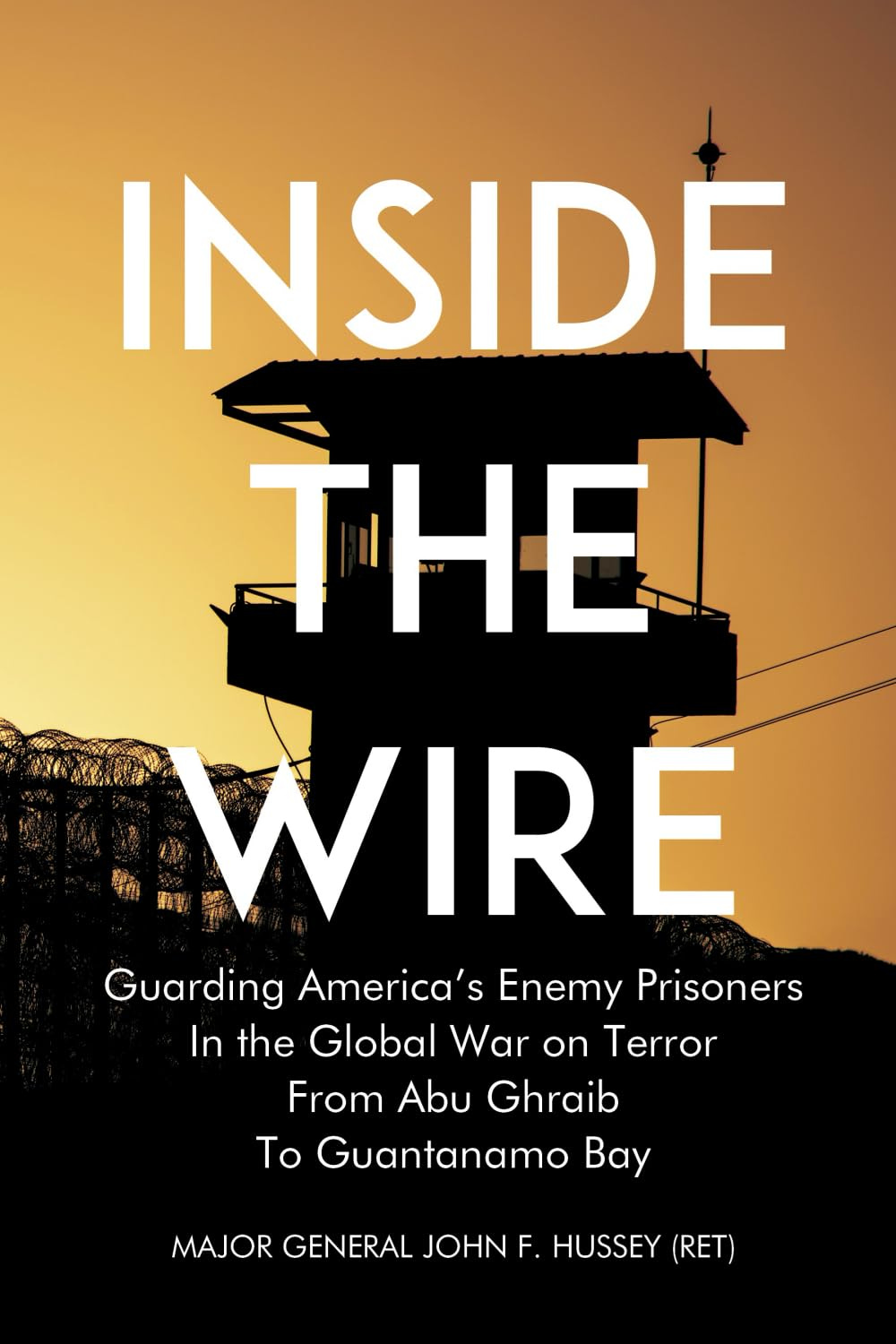
Another book has come out that reminded me of that. It’s by retired Army Reserve Major General John Hussey - Inside the Wire: Guarding America’s Enemy Prisoners in the Global War on Terror from Abu Ghraib to Guantanamo Bay . He arrived in Iraq in the aftermath of that fiasco of 2004 and in GTMO several years ago. His book is about his professional experiences - both military and civilian - with detention operations and the legal system. The book has much value, but for this post, I’d like to focus on a sub-chapter comprising about ten pages.
General Hussey was the Deputy Commander of Joint Task Force Guantanamo Bay (hereafter JTF or GTMO) when I served there. It is safe to call him “a soldier’s general,” or even in this case, “a sailor’s general.” He was tough, but fair. His experience was evident and extremely helpful. His insights, based on that expertise, led to some of the best questions around. Equally important, General Hussey got to know the troops. Unlike some senior officers who may be aloof, in the galley he sat at any table to share a meal, swap some stories, and listen intently to any concerns that he might help with. I was one of those with whom he shared a meal or two. I got to know him a bit - in fact, when he organized the first Guantanamo Bay St. Patrick’s Day Parade on the naval base, he called to ask me to lead it since I was the only bagpiper around. He was, without hyperbole, a great leader you want to follow.
We were lucky at GTMO since we had two superb leaders in the 2018-19 period. The other was Rear Admiral John Ring, the Commander of JTF-GTMO whom I briefed a few times and conveyed greetings at the galley on behalf of a couple of pilots I knew who earlier had served under him. Ring was a thoughtful, measured leader with an easy, affable style. He was a model of positivity in a leader. He ensured we did everything by the book and adhered to parameters of the mission “to conduct the safe, human care and custody of detained enemy combatants.” For anyone wishing to suggest the first few years of GTMO were the same as the 2010s or 2020s have no basis for making that assessment or have an agenda.
Admiral Ring and his wife were equally visible helping the sailors, soldiers and airmen assigned to the command and I seem to recall both served practically every weekend at the Catholic services at Our Lady of Cobre, the chapel at the naval base (to distinguish it from the JTF which has its own area and command structure.) As someone who had devoted his career and attentions to the future of our Navy for decades, I knew Admiral Ring was off to an assignment in the Pacific and I was gratified that our Navy had someone like him moving up in a key region of the world.
As Hussey observes in his book, the command climate was excellent, Ring was respected by all, the detainees were well treated, and Ring was “relentlessly committed to his troops.”
Yes. We were lucky to have two such leaders. What could go wrong…
In the spring of 2019, shortly after I left, Admiral Ring was relieved by Admiral Fallon and General Hussey took command. There were plenty of media reports about it but they don’t report the facts as Hussey does in the direct and to the point sub-chapter titled “The Story of How Admiral John Ring was Falsely Relieved of Duty.”
While this chapter is about DO operations at GTMO, I must include a disturbing story of how Admiral Ring was relieved of his command due to a false accusation from a lower-level intelligence officer…
Hussey tells the story of “the J2 making up a story that jeopardized both the Admiral and me” about a breach of security and going outside the chains of command to report it.
Though Hussey doesn’t recount this in the book, the so-called “breach” did not originate with Hussey or Ring - it originated in the J2 shop with the J2’s senior NCO and civilian security manager.
I called the J2 into my office late Monday morning to justify his insubordination when I had told him I would take care of the breach. He tried to blame going to [the] Admiral’s house on being short of staff, stating to me, “Sir, since I got to the JTF, we have been short on personnel.” But his excuse made no sense. I snapped back hard and fast, saying, “no, being short in your office had nothing to do with your going to Admiral Ring’s house…after I told you to stand down, that I would take care of it.” Point blank, he was caught in a lie and could not wiggle out of it.
Hussey continues with the line of lies that emerged from the J2 and NCO.
Regarding the “shortage,” I can attest there was no shortage. For most of this period, I was the Deputy J2 and one of my duties was to assess the annual manning document. When I completed my analysis, I recommended that we were overstaffed by a few billets and pointed them out. When I reported my findings to the J2, he summoned every bit of air to proclaim, “XO, we will NOT report we have too many billets. We will NOT lose billets while I am in command. Is that understood?” I did what Deputies and XOs do when their CO has made a decision: “Understood, sir.” It was the same dismissiveness when he told me to write up a justification for the command’s Imminent Danger Pay, which I disagreed and stated my perspectives but carried out the order when he demanded the command continue to receive IDP.
The J2 and NCO had successfully forced the security manager out a couple of months after I arrived. Much later, the J2 assigned me to do a job search and make a hiring recommendation to him. Here was my process that the J2 approved:
Identified two senior civilians to join me on a hiring panel so that it wasn’t a one-person decision.
I established criteria upon which each resume would be assessed and graded.
Upon identifying the top applicants, we had a list of standard questions to determine their expertise.
Following the interviewers, each person on the panel graded them on each of the criteria again. Based on that matrix, we had a clear leader.
When I approached the J2 with the name, he immediately said, “no, I haven’t heard good things about him from [the senior J2 NCO].” I responded, “sir, we’re not hiring based on opinions. We had objective standards through the process.” He then directed me to ignore the name and went about two or three names down the list to another person and ordered me to submit that name. Again, I had an order. Only later did I learn that the person he selected was one of the NCO’s smoking buddies at the base. And that who was involved in the so-called breach episode. While I can’t be certain, I don’t think the person the panel recommended would have made the error that led to the episode Hussey refers to.
The J2 had reported the “breach” to SOUTHCOM, which Hussey argues, made it appear that neither of the leaders had done their job.
It demonstrated a lack of professionalism…the Admiral had done his duty to notify SOUTHCOM of the violation.
An investigation ensued with a SOUTHCOM investigator and their civilian J2. The senior J2 NCO threw a Military Whistleblower Protection Act against Hussey.
The senior NCO that I threatened to throw off the island claimed I was retaliating against her for reporting the security breach to SOUTHCOM. Her claim was false, as I accused her of lying to me, not for reporting the breach."
What follows is the investigation itself with a SOUTHCOM J2 and investigator predisposed with “tunnel vision” and “confirmation bias” to a problem - this is not only Hussey’s assessment, but that of other people questioned whom I worked with. The NCO and security manager even tried to put the blame on another colleague who, fortunately, had all the emails to back them up when challenged.
As mentioned, Hussey argues Ring’s departure was a hit job by the J2 and his senior NCO. I concur. I witnessed enough behavior and actions that were questionable with the J2. In another case, the J2 kept complaining about a Navy NCO’s work on the security team. Again, I suggested that she was one of the best qualified people we had and that she was making good points. He kept saying she was worthy of being court-martialed. I asked if instead, he’d let me work with her on a project. Again, I found nothing but professionalism and an expertise. It didn’t matter. He wanted her off the island.
There was a trend about the J2 and the security shop and ridding people who did things by the book. More on this story may emerge someday by some future historian. Who knows. But I’m glad someone senior finally shines a light on what happened to correct history.
What did we get from that team of the J2 and his ever-present NCO? The relief of a good man and Navy leader. We as a Navy deprived and diminished by Ring’s early departure and later retirement.
More importantly, Hussey’s subchapter again shines a light on how processes are used and manipulated by some to advance their own cause, whatever that might be, or to dispense with people they don’t want. I know of one Navy command where leadership called senior people to tell them to stay out of the investigation since they were going to use it to get rid of “x.” Inspector General investigations can be like that. While they are supposed to identify problems and make recommendations, they are sometimes used instead to besmirch, undermine, and eliminate someone. And always fact check and bring the receipts. In one IG I was involved with, the IG said he’d take notes and to trust that he’d get my answers down. I asked that it be recorded. When he said he had no device, I offered one and pressed the issue that I would not answer his questions unless he agreed to a recording. Still, when he sent me the summary, nearly half of the 16 pages were absolutely not what I answered, and I corrected each statement with a time stamp from my recording. Whether or not my corrections made it to his seniors, I doubt it. But don’t trust an IG. Seriously.
There will be more on that later issue. For now, read General Hussey’s book on an excellent assessment of detainee operations at GTMO and elsewhere. It’s a different history of the past 30 years of US operations. This should be in someone’s core curriculum.
To paraphrase an old Skipper of mine: "There's no system designed to be as fair and unbiased as it possibly can be, that it cannot be abused by malefactors." Sadly, not an outlier.
What makes it even worse is that the system has been abused by so many, so often, that those who do have very probable and genuine grievances and issues get their concerns looked at with the same suspicion as those who are abusing the system for their own personal gain.
“Inspector General investigations … are sometimes used instead to besmirch, undermine, and eliminate someone. “
Bingo